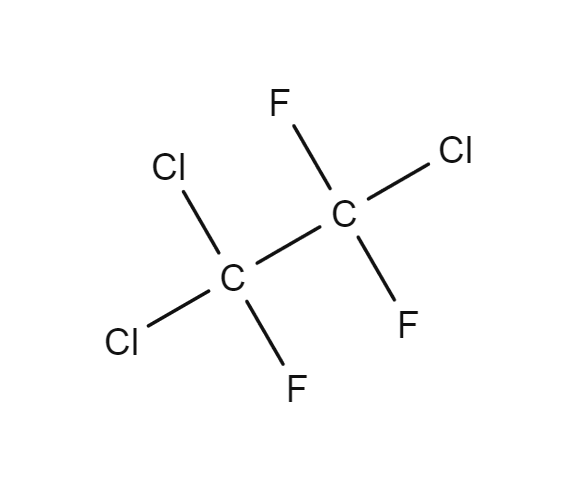
1,1,2-Trichloro-1,2,2-trifluorethane
- C2F3Cl3
- CAS Number 76-13-1
- UN3082 (gas)
Click & drag to move the 3D molecule
Liquid / Gas Volumes
Calculate the volume or mass of a quantity of gas or liquid
Liquid Phase
At boiling point at 1.013 bar
Gas Phase
In standard conditions (1.013 bar, 15°C)
Physical Properties
Molecule phase diagram showing the transition phases between solid, liquid and gas as a function of temperature and pressure
-
- Molar mass 187.376 g/mol
- Content in dry air /
-
Critical Point
- Temperature 214.10 °C
- Pressure 34.1 bar
- Density 576.54 kg/m³
-
Triple Point
- Temperature -36.22 °C
- Pressure 1.852E-2 bar
Pressure 1.013 bar
| Latent heat of fusion (at melting point) | 13.166 kJ/kg |
| Melting point | - 36.23 °C |
Pressure 1.013 bar
| Boiling point | 47.59 °C |
| Latent heat of vaporization (at boiling point) | 144.319 kJ/kg |
| Liquid density (at boiling point) | 1508.179 kg/m3 |
Applications
Examples of uses of this molecule in Industry and Healthcare

Other
1,1,2-Trichloro-1,2,2-trifluoroethane (R113) is used as a coolant in air conditioners and refrigerators. It would also be used as aerosol propellant or as a cleaning agent for electronic components.
Safety & Compatibility

GHS09
Hazardous to the environment
Threshold of toxicity
| PEL USA OSHA (vol) | 1000 ppm |
| VLEP 8h France (at Patm and 293.15 K) | 7600 mg/m3 or 1000 ppm |
| VLEP CT France (at Patm and 293.15 K) | 9500 mg/m3 or 1250 ppm |
Odor
Slightly ethereal
Metals
| Aluminium | Satisfactory |
| Brass | Satisfactory |
| Monel | Satisfactory |
| Copper | No data |
| Ferritic Steel | Satisfactory |
| Stainless steel | Satisfactory |
| Zinc | No data |
| Titanium | No data |
Plastics
| Polytetrafluoroethylene | Satisfactory |
| Polychlorotrifluoroethylene |
Significant swelling
Acceptable
|
| Polyvinylidene fluoride | Satisfactory |
| Polyvinyl chloride |
Significant loss of mass
Not recommended
|
| Ethylene tetrafluoroethylene | No data |
| Polycarbonate | No data |
| Polyamide |
Significant loss of mass
Not recommended
|
| Polypropylene | Satisfactory |
Elastomers
| Butyl (isobutene- isoprene) rubber |
Significant swelling
Not recommended
|
| Nitrile rubber |
Significant swelling
Acceptable
|
| Chloroprene |
Significant swelling
Acceptable
|
| Chlorofluorocarbons | No data |
| Silicone |
Significant swelling
Not recommended
|
| Perfluoroelastomers |
Significant swelling
Acceptable
|
| Fluoroelastomers |
Significant swelling
Acceptable
|
| Neoprene | No data |
| Polyurethane |
Significant swelling
Not recommended
|
| Ethylene-Propylene |
Significant swelling
Not recommended
|
Lubricants
| Hydrocarbon based lubricant |
Significant loss of mass
Not recommended
|
| Fluorocarbon based lubricant |
Significant loss of mass
Not recommended
|
Materials compatibility
Learn More
More information
Due to their ozone-depleting effect, the production of refrigerants is continuously decreasing, based on Montreal protocol requirements. Their use is controlled and they are progressively being replaced.