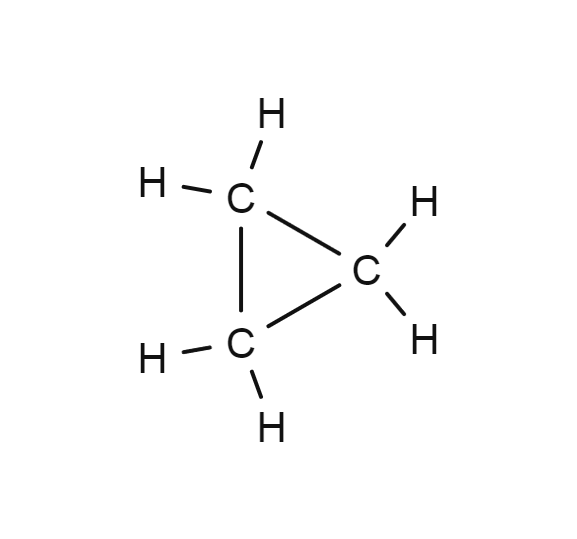
Cyclopropane
- C3H6
- CAS Number 75-19-4
- UN1027 (gas)
Click & drag to move the 3D molecule
Liquid / Gas Volumes
Calculate the volume or mass of a quantity of gas or liquid
Liquid Phase
At boiling point at 1.013 bar
Gas Phase
In standard conditions (1.013 bar, 15°C)
Physical Properties
Molecule phase diagram showing the transition phases between solid, liquid and gas as a function of temperature and pressure
-
- Molar mass 42.081 g/mol
- Content in dry air /
-
Critical Point
- Temperature 124.85 °C
- Pressure 55.4 bar
- Density 259.75 kg/m³
-
Triple Point
- Temperature -127.56 °C
- Pressure 7.796E-4 bar
Pressure 1.013 bar
| Latent heat of fusion (at melting point) | 129.274 kJ/kg |
| Melting point | - 127.56 °C |
Pressure 1.013 bar
| Boiling point | - 31.48 °C |
| Latent heat of vaporization (at boiling point) | 471.56 kJ/kg |
| Liquid density (at boiling point) | 679.905 kg/m3 |
| Compressibility factor Z | 9.779E-1 |
| Cp/Cv ratio γ | 1.2136 |
| Gas density | 1.9194 kg/m3 |
| Gas/(liquid at boiling point) equivalent | 354.23 vol/vol |
| Heat capacity Cp | 1.2501 kJ/(kg.K) |
| Heat capacity Cv | 1.0301 kJ/(kg.K) |
| Specific gravity | 1.45 |
| Specific volume | 5.21E-1 m3/kg |
| Thermal conductivity | 13.518 mW/(m.K) |
| Vapor pressure | 3.4701 bar |
| Viscosity | 8.165E-5 Po |
| Compressibility factor Z | 9.8167E-1 |
| Cp/Cv ratio γ | 1.1968 |
| Gas density | 1.8125 kg/m3 |
| Gas/(liquid at boiling point) equivalent | 375.12 vol/vol |
| Heat capacity Cp | 1.3129 kJ/(kg.K) |
| Heat capacity Cv | 1.097 kJ/(kg.K) |
| Specific gravity | 1.45 |
| Specific volume | 5.517E-1 m3/kg |
| Thermal conductivity | 14.96 mW/(m.K) |
| Vapor pressure | 5.4973 bar |
| Viscosity | 8.6113E-5 Po |
| Compressibility factor Z | 9.8371E-1 |
| Cp/Cv ratio γ | 1.1869 |
| Gas density | 1.7481 kg/m3 |
| Gas/(liquid at boiling point) equivalent | 388.94 vol/vol |
| Heat capacity Cp | 1.3567 kJ/(kg.K) |
| Heat capacity Cv | 1.1431 kJ/(kg.K) |
| Solubility in water | 2.769E-1 mol/mol |
| Specific gravity | 1.45 |
| Specific volume | 5.721E-1 m3/kg |
| Thermal conductivity | 15.961 mW/(m.K) |
| Vapor pressure | 7.2641 bar |
| Viscosity | 8.9055E-5 Po |
Applications
Examples of uses of this molecule in Industry and Healthcare
Safety & Compatibility

GHS02
Flammable

GHS04
Gas under pressure
Autoignition Temperature, Flammability Limits & Flash Point
Europe (according to EN1839 for Limits and EN 14522 for autoignition temperature)
| Autoignition temperature (Chemsafe) | 495 °C |
| Lower flammability limit (IEC 80079-20-1) | 2.4 vol% |
| Upper flammability limit (IEC 80079-20-1) | 10.4 vol% |
US (according to ASTM E681 for Limits and ASTM E659 for autoignition temperature)
| Autoignition temperature (NFPA 325) | 498 °C |
| Lower flammability limit (NFPA 325) | 2.4 vol% |
| Upper flammability limit (NFPA 325) | 10.4 vol% |
Odor
Petroleum Ether
Metals
| Aluminium | Satisfactory |
| Brass | Satisfactory |
| Monel | No data |
| Copper | No data |
| Ferritic Steel | Satisfactory |
| Stainless steel | Acceptable |
| Zinc | No data |
| Titanium | No data |
Plastics
| Polytetrafluoroethylene | Satisfactory |
| Polychlorotrifluoroethylene | Satisfactory |
| Polyvinylidene fluoride | Satisfactory |
| Polyvinyl chloride | Satisfactory |
| Ethylene tetrafluoroethylene | No data |
| Polycarbonate | No data |
| Polyamide | Satisfactory |
| Polypropylene | Satisfactory |
Elastomers
| Butyl (isobutene- isoprene) rubber |
Significant swelling
Not recommended
|
| Nitrile rubber | Satisfactory |
| Chloroprene |
Significant swelling
Not recommended
|
| Chlorofluorocarbons | No data |
| Silicone |
Significant swelling
Not recommended
|
| Perfluoroelastomers | Satisfactory |
| Fluoroelastomers | Satisfactory |
| Neoprene | No data |
| Polyurethane | Satisfactory |
| Ethylene-Propylene |
Significant swelling
Not recommended
|
Lubricants
| Hydrocarbon based lubricant |
Significant loss of mass
Not recommended
|
| Fluorocarbon based lubricant | Satisfactory |
Materials compatibility
Learn More
More information
Cyclopropane was discovered in 1881 by August Freund, who also proposed the correct structure for the new substance in his first paper.